Boron Dosage: How Much to Take (and Why More Isn't Better)
3 mg of boron a day is the amount most mineral and bone studies used; short hormone trials used 2.5 to 10 mg. Our pick, NOW Boron, gives 3 mg in one capsule, and the US upper limit for adults is 20 mg a day. Boron is not an essential nutrient, so there is no RDA.
Based on published research, not medical advice. Pregnant, breastfeeding, or giving it to a child? Ask your doctor first.
Costs are brand or Vitacost prices, checked October 19, 2026.
Which boron is right for you?
Most products give 3 mg in one capsule, so price and what else is in the capsule decide. Here are two other choices.
Want a brand certificate of analysis? One capsule.
Life Extension gives the same 3 mg for $0.05 a day at its own price and offers a certificate of analysis, which names no lab. Each capsule also has 25 mg of vitamin B2.

Life Extension Boron
3 mg in 1 capsule · plus 25 mg vitamin B2
Want the amount used in hormone trials? One tablet.
Vitamatic gives 10 mg in one tablet for $0.07 a day at its own price. That is the amount in short hormone trials, whose results disagree. It is half the US adult limit of 20 mg and equal to the 10 mg limit the European Food Safety Authority uses.
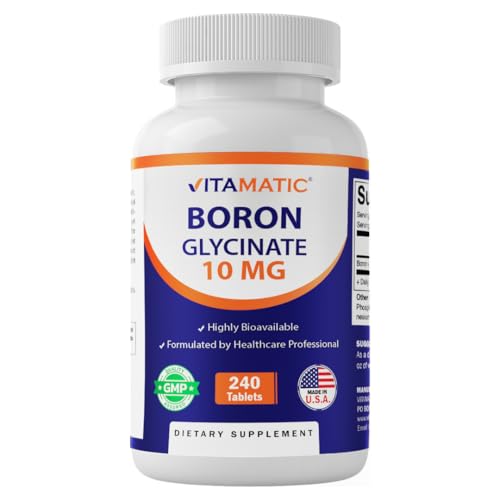
Vitamatic Chelated Boron 10 mg
10 mg in 1 tablet · half the US limit
Taking more than one product with boron?
Add up the boron in all of them, including multivitamins and joint formulas. Stay under 20 mg a day for adults, and lower for children.
How much boron per day
Food gives most adults about 1 to 1.5 mg a day (NIH Office of Dietary Supplements). In 12 women past menopause who had eaten almost no boron for months, 3 mg a day lowered calcium and magnesium lost in urine and raised estrogen and testosterone (Nielsen 1987). In other women past menopause, 3 mg a day for 3 weeks changed nothing (Beattie 1993). Hormone trials disagree: 10 mg a day for a week changed hormone levels in 8 men (Naghii 2011), while 2.5 mg a day for 7 weeks did nothing in 19 bodybuilders (Ferrando 1993). For knee discomfort, 6 mg a day of boron as calcium fructoborate for 2 weeks helped 60 adults in one trial (Pietrzkowski 2014).
Upper limits by age
The NIH upper limit is 3 mg a day for ages 1 to 3, 6 mg for 4 to 8, 11 mg for 9 to 13, 17 mg for 14 to 18, and 20 mg for adults, including in pregnancy. It was set from animal studies. The European Food Safety Authority uses a lower adult limit, 10 mg a day (Stübing 2026), and the World Health Organization puts a safe range for adults at 1 to 13 mg a day.
How to take it
- Take one 3 mg capsule a day with a meal.
- Do not give adult boron products to children without asking a doctor; their limits are lower.
Work out your daily boron
Enter the boron milligrams per serving from your label and how many servings you take a day.
Questions people ask
Is there a boron RDA?
No. Boron is not classified as an essential nutrient, and the NIH found the data too thin to set a recommended amount (NIH Office of Dietary Supplements). There is only an upper limit.
Can I take more for a stronger effect?
Doses above 10 mg a day have barely been tested, so we do not know if more helps. A 10 mg tablet is already half the 20 mg US adult upper limit.
Is boron safe?
The NIH lists no known drug interactions. It has no data on harm from boron in food or water, which is not proof of safety, and its 20 mg limit comes from animal studies of harm to reproduction and growth. Count every product with boron, and if you are pregnant or breastfeeding, ask your doctor first.
Related guides
- Best boron: the products we compared, ranked
- Boron guide: what the research found for each goal
Sources
- NIH Office of Dietary Supplements. “Boron: Fact Sheet for Health Professionals.” ods.od.nih.gov
- Nielsen FH, et al. “Effect of dietary boron on mineral, estrogen, and testosterone metabolism in postmenopausal women.” FASEB J. 1987. PubMed 3678698
- Beattie JH, et al. “The influence of a low-boron diet and boron supplementation on bone, major mineral and sex steroid metabolism in postmenopausal women.” Br J Nutr. 1993. PubMed 8329361
- Naghii MR, et al. “Comparative effects of daily and weekly boron supplementation on plasma steroid hormones and proinflammatory cytokines.” J Trace Elem Med Biol. 2011. PubMed 21129941
- Ferrando AA, et al. “The effect of boron supplementation on lean body mass, plasma testosterone levels, and strength in male bodybuilders.” Int J Sport Nutr. 1993. PubMed 8508192
- Stübing F, et al. “Boron Intake and 24-hour Urinary Excretion in Long-term Omnivores, Vegetarians and Vegans: a Cross-sectional Study.” Biol Trace Elem Res. 2026. PubMed 42581205
- Pietrzkowski Z, et al. “Short-term efficacy of calcium fructoborate on subjects with knee discomfort: a comparative, double-blind, placebo-controlled clinical study.” Clin Interv Aging. 2014. PubMed 24940052