Magnesium Glycinate: Best Supplements, Uses, Dose and Side Effects (2026)
By Erin Rose Updated October 15, 2026 Sources
Magnesium glycinate is magnesium bound to glycine, an amino acid. It is one common way to take a magnesium supplement. Adults need 310 to 420 mg of magnesium a day from food and pills together, and should keep pills at or under 350 mg a day (NIH). For sleep, a 2025 glycinate trial found a small benefit at 250 mg. Our pick is Nature Made Magnesium Glycinate: 200 mg in 2 capsules, USP Verified, $0.73 a day at list price.
We earn a commission if you buy through our links. It never changes a score or a pick. How we make money
Our pick
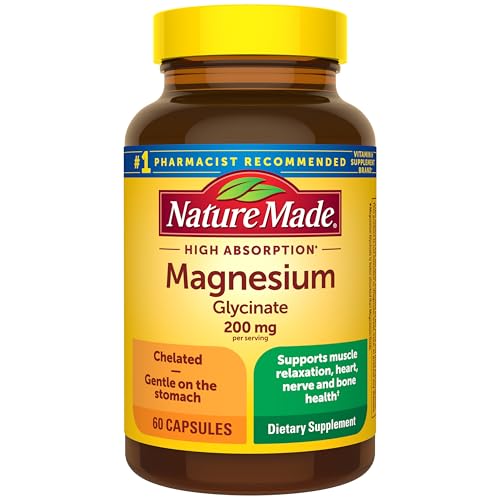
Nature Made Magnesium Glycinate 200 mg
200 mg of magnesium in 2 capsules, $0.73 a day at Nature Made’s list price. We pick it because it is on USP’s testing list. Nutricost costs less at list price and scores higher, but it is on no testing list.
Check price on Amazon- Dose it by the tablet: Vitamin Shoppe Magnesium Glycinate. 135 tablets, 133 mg each. Take 1 or 2: the 3-tablet serving (400 mg) is over the limit. Not on a testing list. Check price
- The lowest cost we score: Nutricost Magnesium Glycinate 210 mg, 210 mg in 3 capsules, $0.21 a serving at list price. Not on a testing list. Check price
Best magnesium glycinate supplements: cost and testing compared
The 6 glycinates we score, ranked by what 300 mg of magnesium costs at each brand’s own list price, cheapest first. 300 mg is a yardstick for comparing prices, not a dose to aim for. 3 of the 10 glycinates we track are on a public testing list (which ones).
| Product and size | Per 300 mg | A serving | A year at 300 mg a day |
|---|---|---|---|
| 1 Nutricost Magnesium Glycinate 210 mg 360-capsule bottle, list $24.97, 210 mg magnesium in 3 capsulesNo testing list found · score 8.5/10 | $0.30 | $0.21 | $109 |
| 2 NOW Magnesium Bisglycinate Powder 8 oz tub, list $23.99, 300 mg magnesium in 1 level teaspoonNo testing list found · score 7.0/10 | $0.32 | $0.32 | $115 |
| 3 Doctor's Best High Absorption Magnesium 120-tablet bottle, list $13.99, 200 mg magnesium in 2 tabletsNo testing list found · score 7.0/10 | $0.35 | $0.23 | $128 |
| 4 NOW Magnesium Glycinate 200 mg 180-tablet bottle, list $31.99, 200 mg magnesium in 2 tabletsNo testing list found · score 6.0/10 | $0.53 | $0.36 | $195 |
| 5 Thorne Magnesium Glycinate 90-serving bottle, list $26.00, 120 mg magnesium in 1 capsuleNSF/ANSI 173 · score 6.5/10 | $0.72 | $0.29 | $264 |
| 6 Nature Made Magnesium Glycinate 200mgOur pick 60-count bottle, list $21.99, 200 mg magnesium in 2 capsulesUSP Verified · score 8.0/10 | $1.10 | $0.73 | $401 |
Linked, not ranked
- BulkSupplements Magnesium Glycinate Powder: 300 mg in ¾ teaspoon (2.2 g), $0.19 per 300 mg at list price · NSF/ANSI 173. Its label says the magnesium comes from glycinate and oxide together, so it is a blend, not pure glycinate.
- KAL Magnesium Glycinate 350: 350 mg in 4 capsules. KAL’s own store sells only a smaller bottle, so we have no list price for this one.
- Nature’s Bounty Magnesium Glycinate 240 mg: 240 mg in 2 capsules. Nature’s Bounty sells nothing on its own site, so we have no list price.
The score (out of 10) weighs testing, dose, cost, the label and recalls, and compares glycinates with each other only (how we score). We pick from products on a testing list, which is why our pick is not the cheapest. Amazon’s price can differ from these list prices. For the buying guide, see the best magnesium glycinate.
Every bottle size the brands sell (11)
| Product | Size | List price | Per 300 mg |
|---|---|---|---|
| Nutricost Magnesium Glycinate 210 mg | 360 Capsules (linked) | $24.97 | $0.30 |
| Doctor's Best High Absorption Magnesium | 240 Tablets | $23.99 | $0.30 |
| NOW Magnesium Bisglycinate Powder | 8 oz. (linked) | $23.99 | $0.32 |
| Doctor's Best High Absorption Magnesium | 120 Tablets (linked) | $13.99 | $0.35 |
| Nutricost Magnesium Glycinate 210 mg | 180 Capsules (out of stock at the brand) | $16.97 | $0.40 |
| NOW Magnesium Glycinate 200 mg | 180 Tablets (linked) | $31.99 | $0.53 |
| Nutricost Magnesium Glycinate 210 mg | 90 Capsules | $11.97 | $0.57 |
| NOW Magnesium Glycinate 200 mg | 90 Tablets | $17.99 | $0.60 |
| Thorne Magnesium Glycinate | 180 Servings | $46.00 | $0.64 |
| Thorne Magnesium Glycinate | 90 Servings (linked) | $26.00 | $0.72 |
| Nature Made Magnesium Glycinate 200mg | 60 Count (linked) | $21.99 | $1.10 |
What is magnesium glycinate?
Magnesium glycinate is magnesium bound to glycine, the simplest amino acid. Labels also call it magnesium bisglycinate; it is the same thing. About 14% of the compound’s weight is magnesium. The “Magnesium” line on the Supplement Facts panel is the magnesium itself (the elemental amount), not the weight of the whole compound (NIH). So “200 mg” on that line means 200 mg of magnesium, while a capsule sold as “1,000 mg magnesium glycinate” holds only about 140 mg.
Magnesium helps more than 300 enzymes, including those for muscles, nerves, blood sugar and blood pressure (NIH). Glycinate is one way to take it. People often choose it because it has a name for being gentle on the stomach. One small trial backs that up: in 12 people who had part of their small bowel removed, glycinate was absorbed about as well as oxide (23.5% vs 22.8%) and was better tolerated by every patient (Schuette 1994). NIH says nothing about how well glycinate is absorbed.
What magnesium glycinate is used for, and what studies show
Most of what is known comes from studies of magnesium in other forms. Few trials tested glycinate itself: a 2025 sleep trial (250 mg a day for 4 weeks, a small benefit; Schuster 2025), a pregnancy leg-cramp trial (300 mg of magnesium bisglycinate a day for 4 weeks, fewer and milder cramps; Supakatisant 2015) and a small absorption trial against oxide (12 people; Schuette 1994).
| Use | What studies show | Evidence |
|---|---|---|
| Low magnesium from food | 48% of Americans get less magnesium from food than they need (NIH). Any form, glycinate included, fills that gap. | Clear |
| Sleep | In 3 small trials in older adults, magnesium helped people fall asleep about 17 minutes faster; total sleep did not change much (Mah 2021). A 2025 glycinate trial, 250 mg for 4 weeks in 155 adults, found a small benefit (Schuster 2025). | Weak |
| Anxiety and stress | A 2017 review found a hint of benefit in people prone to anxiety, but rated the studies poor (Boyle 2017). No study shows glycinate works better than other forms. | Weak |
| Muscle cramps | A Cochrane review of 11 trials found magnesium unlikely to help the night cramps of older adults (Garrison 2020). In pregnancy, one trial of 300 mg of magnesium bisglycinate a day for 4 weeks found fewer and milder cramps (Supakatisant 2015). | Weak; pregnancy: one trial |
| Blood pressure | Across 38 trials, magnesium lowered the top number by about 3 points on average. The drop was mostly in people with high blood pressure; normal blood pressure did not change (Argeros 2025). | Small |
| Constipation | Not the form to pick. In 2 trials of magnesium oxide, 68% improved vs 19% on placebo (van der Schoot 2023). | Use oxide or citrate |
Sleep trials of plain magnesium used 250 to 729 mg of magnesium a day, including a 2025 trial of 250 mg as glycinate (Schuster 2025). Trials of magnesium L-threonate are separate: they used 1 to 2 g of the compound, about 72 to 144 mg of magnesium. Magnesium and sleep · magnesium and cramps.
How much magnesium glycinate to take
- Your daily need: 310 to 420 mg of magnesium a day for adults, from food and supplements together (NIH).
- The limit for pills: The upper limit for adults is 350 mg a day of magnesium from supplements and medicines. Food does not count toward it (NIH).
- In practice: one serving of 200 to 300 mg covers most people’s gap. Our pick’s 2 capsules give 200 mg. Thorne’s capsule gives 120 mg.
- Count the magnesium, not the capsules. Read the magnesium line on the Supplement Facts panel, not the number on the front.
How much magnesium per day, by age · for older adults.
Side effects, and who should not take it
- Most common: Too much magnesium from pills most often causes diarrhea, sometimes with nausea and stomach cramps. That is why the limit is set where it is (NIH).
- Rare but serious: very high blood levels, mostly from huge doses of magnesium laxatives or antacids, can cause low blood pressure, nausea, flushing, muscle weakness and an irregular heartbeat (NIH).
- Kidney disease: If you have kidney disease, ask your doctor before you take magnesium. Weak kidneys cannot clear the extra, so it can build up (NIH).
- Medicines: Antibiotics: take tetracyclines (such as doxycycline) or quinolones (such as ciprofloxacin) at least 2 hours before or 4 to 6 hours after magnesium (NIH). Osteoporosis drugs (bisphosphonates such as alendronate): take them at least 2 hours apart from magnesium (NIH).
All magnesium side effects and medicine interactions.
Magnesium glycinate vs other forms
| Form | Magnesium | What is known |
|---|---|---|
| Glycinate | 14% | No absorption data from NIH. In one small trial, absorbed about as well as oxide and better tolerated. |
| Citrate | 16% | Absorbed better than oxide in small studies (NIH). Can loosen stools. |
| Oxide | 60% | About 4% was absorbed in one study (Firoz 2001). Works as a laxative. |
No trial shows glycinate works better than citrate. Glycinate vs citrate: which to take · every form compared.
Is your glycinate really glycinate?
Read the words in brackets on the magnesium line. “(as magnesium glycinate)” or “(as magnesium bisglycinate)” means glycinate only; if oxide is named too, it is a blend. BulkSupplements’ powder is one: its label names glycinate and oxide. In November 2025, Health Canada recalled two 200 mg bisglycinate products, Life Brand and MapleLife, because they held magnesium oxide the label did not list. How to check your bottle.
Questions
Is magnesium glycinate the same as magnesium bisglycinate?
Yes. Bisglycinate is the full chemical name: one magnesium bound to two glycines. Labels use both names, and some say “chelate.” Check the words in brackets on the magnesium line: if oxide is named too, the product is a blend.
Does magnesium glycinate make you sleepy?
Not in a way you would feel right away. In a 2025 trial of glycinate, adults who took 250 mg of magnesium as bisglycinate 30 to 60 minutes before bed for 4 weeks rated their sleep a little better than those on placebo (Schuster 2025). Magnesium and sleep.
Can I take magnesium glycinate every day?
Yes, if you stay within the limit for pills and your kidneys work normally. Daily use is how it was taken in the trials, for 3 to 12 weeks. Count the magnesium in every product you take, including multivitamins and antacids.
When should I take magnesium glycinate?
At a time you will remember. Many people take it in the evening. Take it with food if it upsets your stomach, and space it from some antibiotics and osteoporosis drugs. Best time to take magnesium.
How long does magnesium glycinate take to work?
If you are low, levels rise over weeks, not days. The sleep trials ran 3 to 8 weeks (Mah 2021), and the glycinate sleep trial 4 weeks (Schuster 2025).
Who should not take magnesium glycinate?
People with kidney disease, unless their doctor says so, because weak kidneys cannot clear the extra magnesium (NIH). People on tetracycline or quinolone antibiotics, bisphosphonates for bone loss, or water pills should check the timing or dose with a pharmacist.
More on magnesium glycinate
- Best magnesium glycinate · third-party tested glycinate · Thorne vs Doctor’s Best
- Magnesium dosage guide · best time to take it · side effects · magnesium guide
Sources
- NIH Office of Dietary Supplements. Magnesium fact sheet for health professionals (updated January 6, 2026; read October 14, 2026).
- Schuster J, et al. Magnesium bisglycinate supplementation in healthy adults reporting poor sleep: a randomized, placebo-controlled trial. Nat Sci Sleep. 2025. PubMed 40918053
- Mah J, Pitre T. Oral magnesium supplementation for insomnia in older adults. BMC Complement Med Ther. 2021. PubMed 33865376
- Boyle NB, et al. The effects of magnesium supplementation on subjective anxiety and stress: a systematic review. Nutrients. 2017. PubMed 28445426
- Garrison SR, et al. Magnesium for skeletal muscle cramps. Cochrane Database Syst Rev. 2020. PubMed 32956536
- Barna O, et al. Magnesium oxide monohydrate in the treatment of nocturnal leg cramps: a randomized, placebo-controlled trial. Nutr J. 2021. PubMed 34719399
- Argeros Z, et al. Magnesium supplementation and blood pressure. Hypertension. 2025. PubMed 41000008
- van der Schoot A, et al. The effect of food, vitamin, or mineral supplements on chronic constipation in adults. Neurogastroenterol Motil. 2023. PubMed 37243443
- Supakatisant C, Phupong V. Oral magnesium for relief in pregnancy-induced leg cramps: a randomised controlled trial. Matern Child Nutr. 2015. PubMed 22909270
- Schuette SA, et al. Bioavailability of magnesium diglycinate vs magnesium oxide in patients with ileal resection. JPEN J Parenter Enteral Nutr. 1994. PubMed 7815675
- Firoz M, Graber M. Bioavailability of US commercial magnesium preparations. Magnes Res. 2001. PubMed 11794633
- Prices: each brand’s own list price for every size it sells, checked October 14, 2026. We quote no Amazon prices. Testing lists: NSF/ANSI 173, NSF Certified for Sport, USP Verified, Informed Choice and Informed Sport, searched October 14, 2026. Nature Made label: NIH label 322551 (2 capsules = 200 mg).
- Health Canada recalls: Life Brand (November 12, 2025) and MapleLife (November 26, 2025) Magnesium Bisglycinate 200mg, undeclared magnesium oxide.
This page is for information. It is not medical advice.