Best Electrolyte Drink Powder: 10 Compared by Sodium and Testing
The best electrolyte powder for most people is Transparent Labs Hydrate: 500 mg of sodium a scoop and no sugar, for $1.50 per 1,000 mg of sodium, on NSF Certified for Sport, Informed Choice and NSF/ANSI 173. Want the most sodium in one stick? LMNT Recharge Electrolytes has 1,000 mg. If your workouts are short and easy, you don’t need either. We compared 12 products: 10 powders, a tablet and a chew.
By Erin Rose Updated October 19, 2026 How we score
Our picks at a glance
- Stick packs, with some sugar BUBS Naturals Hydrate or Die Electrolytes $2.85 per 1,000 mg sodium, list price
- Less sodium, for shorter workouts Nuun Sport Electrolyte Tablets $2.50 per 1,000 mg sodium, list price


Our pick for: Most people who sweat hard

Transparent Labs Hydrate
10.0/10 Our score
10.0/10, the top score of the 10 electrolyte products we score
Good
- On the NSF Certified for Sport, Informed Choice and NSF/ANSI 173 lists (checked September 30, 2026)
- Full dose: 500 mg sodium per serving (400 mg or more counts in full)
- The lowest cost per dose of its kind that we score
Watch for
Nothing flagged on our five marks.
- Sodium
- 500 mg a scoop250 mg potassium, 50 mg magnesium
- Per 1,000 mg sodium
- $1.50
- Testing lists
- NSF Certified for Sport, Informed Choice and NSF/ANSI 173
- Sugar
- 0 gsweetened with stevia
- Tub
- 40-serving tub, $29.99$0.75 a scoop, brand list price
- Label
- Checked on NSF’s listingNIH’s label database has no entry
Our take
Why we pick it It has enough sodium to matter, no sugar, and it is on three public testing lists. NSF/ANSI 173 checks that the label matches what is in the tub. NSF Certified for Sport and Informed Choice screen for drugs banned in sport, so it also suits athletes who are drug-tested. No tested drink we price gives you sodium for less.
What you give up No sugar, so no fuel for a long race. It is a tub, not stick packs: for sticks, see BUBS Naturals.
The label
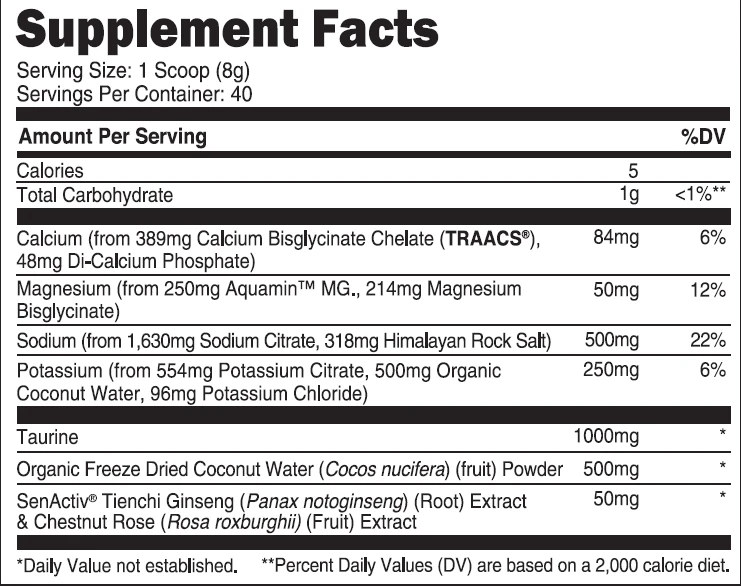
Testing record
- NSF Certified for Sport: banned substances, by lot See the listing Checked September 30, 2026.
- Informed Choice: banned substances, monthly retail samples Checked September 22, 2026.
- NSF/ANSI 173: contents match the label Checked September 30, 2026.
Not found on: Informed Sport, USP Verified.
Our other 5 picks
Each is for a different need: the most sodium in one stick, stick packs with or without sugar, less sodium, or something to chew.
- The most sodium in one stick LMNT Recharge Electrolytes
- Stick packs, with some sugar BUBS Naturals Hydrate or Die Electrolytes
- Stick packs, no sugar Thorne Daily Electrolytes
- Less sodium, for shorter workouts Nuun Sport Electrolyte Tablets
- No mixing SaltStick FastChews Chewable Electrolytes
Our pick for: The most sodium in one stick

Good
- Full dose: 1,000 mg sodium per serving (400 mg or more counts in full)
- The lowest cost per dose of its kind that we score
- Label states the amount, with no blend
Watch for
- Not on any public testing list we check
- Sodium
- 1,000 mg a serving1 stick pack
- Per 1,000 mg sodium
- $1.50
- Testing list
- Not on a testing listWe searched NSF, USP and Informed
- Sugar
- 0 g
- Pack
- 30-stick box, $45.00$1.50 a serving, brand list price
- Potassium
- 200 mg60 mg magnesium
Our take
1,000 mg of sodium in one stick, the most of any drink we score, with no sugar, for the same $1.50 per 1,000 mg as our pick. It suits salty, heavy sweaters in long or hot sessions. It is not our main pick because we did not find it on a public testing list. That usually means the brand did not sign up, not that it failed. If you are drug-tested in sport, take our pick instead.
Testing record
Not found on any testing list we check.
Not found on: NSF Certified for Sport, Informed Sport, Informed Choice, NSF/ANSI 173, USP Verified.
Our pick for: Stick packs, with some sugar

BUBS Naturals Hydrate or Die Electrolytes
9.0/10 Our score
9.0/10, tied for #2 of the 10 electrolyte products we score
Good
- On the NSF Certified for Sport list (checked September 30, 2026)
- Full dose: 650 mg sodium per serving (400 mg or more counts in full)
- Label states the amount, with no blend
Watch for
- Costs 1.9 times as much per dose as the cheapest of its kind we score
- Sodium
- 650 mg a serving1 stick pack
- Per 1,000 mg sodium
- $2.85
- Testing list
- NSF Certified for Sport
- Sugar
- 7 g
- Pack
- 20-stick box, $37.00$1.85 a serving, brand list price
- Potassium
- 200 mg50 mg magnesium
Our take
650 mg of sodium and 7 g of sugar in one stick, on NSF Certified for Sport. It is the stick pack on a testing list with the most sodium. In hard exercise over an hour, the sugar is useful fuel (ACSM 1996). $2.85 per 1,000 mg of sodium. Sticks are easy to carry, but they cost more per serving than a tub.
Testing record
- NSF Certified for Sport: banned substances, by lot See the listing Checked September 30, 2026.
Not found on: Informed Sport, Informed Choice, NSF/ANSI 173, USP Verified.
Our pick for: Stick packs, no sugar

Thorne Daily Electrolytes
9.0/10 Our score
9.0/10, tied for #2 of the 10 electrolyte products we score
Good
- On the NSF Certified for Sport and NSF/ANSI 173 lists (checked September 30, 2026)
- Full dose: 480 mg sodium per serving (400 mg or more counts in full)
- Label states the amount, with no blend
Watch for
- Costs 1.9 times as much per dose as the cheapest of its kind we score
- Sodium
- 480 mg a serving1 stick pack (4.37 g)
- Per 1,000 mg sodium
- $2.78
- Testing list
- NSF Certified for Sport and NSF/ANSI 173
- Sugar
- 0 g
- Pack
- 30-stick box, $40.00$1.33 a serving, brand list price
- Potassium
- 99 mg40 mg magnesium
Our take
480 mg of sodium and 0 g of sugar in one stick, on NSF Certified for Sport and NSF/ANSI 173. It ties BUBS Naturals Hydrate or Die Electrolytes on our score and costs $2.78 per 1,000 mg of sodium, a little less. Pick it if you want sticks without sugar; pick BUBS Naturals if you want more sodium and some fuel.
Testing record
- NSF Certified for Sport: banned substances, by lot See the listing Checked September 30, 2026.
- NSF/ANSI 173: contents match the label Checked September 30, 2026.
Not found on: Informed Sport, Informed Choice, USP Verified.
Our pick for: Less sodium, for shorter workouts

Good
- On the Informed Choice list (checked September 22, 2026)
- Label states the amount, with no blend
- No FDA recall for the brand in 24 months
Watch for
- Below a full dose: 300 mg sodium per serving (400 mg or more counts in full)
- Costs 1.7 times as much per dose as the cheapest of its kind we score
- Sodium
- 300 mg a serving1 tablet
- Per 1,000 mg sodium
- $2.50
- Testing list
- Informed Choice
- Sugar
- 1 g
- Pack
- 80-tablet pack, $59.92$0.75 a serving, brand list price
- Potassium
- 150 mg25 mg magnesium
Our take
300 mg of sodium in one tablet that you drop in water, on Informed Choice. It suits shorter or cooler workouts. An average athlete loses about 1,000 mg of sodium in a hard hour of sweat (Baker 2016); matching all of it would take about 3 tablets, and you do not have to. $2.50 per 1,000 mg of sodium.
Testing record
- Informed Choice: banned substances, monthly retail samples Checked September 22, 2026.
Not found on: NSF Certified for Sport, Informed Sport, NSF/ANSI 173, USP Verified.
Our pick for: No mixing

SaltStick FastChews Chewable Electrolytes
5.0/10 Our score
5.0/10, tied for #6 of the 10 electrolyte products we score
Good
- On the Informed Choice list (checked September 22, 2026)
- Label states the amount, with no blend
- No FDA recall for the brand in 24 months
Watch for
- Below a full dose: 100 mg sodium per serving (400 mg or more counts in full)
- Costs 4.4 times as much per dose as the cheapest of its kind we score
- Sodium
- 100 mg a serving2 chewable tablets
- Per 1,000 mg sodium
- $6.66
- Testing list
- Informed Choice
- Sugar
- 2 g carbs
- Pack
- 60-chew bottle, $19.99$0.67 a serving, brand list price
- Potassium
- 30 mg6 mg magnesium
Our take
Chewable tablets on Informed Choice. Only 100 mg of sodium a serving, so they top up during a run rather than replace a drink. $6.66 per 1,000 mg.
Testing record
- Informed Choice: banned substances, monthly retail samples Checked September 22, 2026.
Not found on: NSF Certified for Sport, Informed Sport, NSF/ANSI 173, USP Verified.
Which electrolyte powders are third-party tested?
3 of the 8 powders we score are on a public testing list:
- Transparent Labs Hydrate (tub): NSF Certified for Sport, Informed Choice and NSF/ANSI 173
- Thorne Daily Electrolytes (stick packs): NSF Certified for Sport and NSF/ANSI 173
- BUBS Naturals Hydrate or Die Electrolytes (stick packs): NSF Certified for Sport
Each list is run by an outside group. NSF/ANSI 173 checks that the label matches what is inside. NSF Certified for Sport and Informed Choice also screen for drugs banned in sport.
Redmond Re-Lyte Hydration sticks are on Informed Choice too, but we don’t score them (see why). We found no listing for LMNT, Liquid I.V., DripDrop and Ultima in the flavor and size we price. Also on a testing list, but not powders: Nuun Sport Electrolyte Tablets and SaltStick FastChews Chewable Electrolytes.
Which one is for you?
| Your situation | What to buy |
|---|---|
| Long or hot workouts, heavy sweating | $1.50, 500 mg a scoop: Transparent Labs Hydrate |
| You are drug-tested in sport | On NSF Certified for Sport and Informed Choice: Transparent Labs Hydrate |
| You want the most sodium in one stick | 1,000 mg a stick, $1.50: LMNT Recharge Electrolytes |
| You want stick packs, or some sugar for a long effort | 650 mg of sodium and 7 g of sugar a stick, $2.85: BUBS Naturals Hydrate or Die Electrolytes |
| Stick packs with no sugar | 480 mg a stick, $2.78: Thorne Daily Electrolytes |
| Shorter workouts, less sodium | 300 mg a tablet, $2.50: Nuun Sport Electrolyte Tablets |
| Something to chew mid-run | 100 mg a serving: SaltStick FastChews Chewable Electrolytes |
| A salty stick on Informed Choice | Also on a testing list. We could not read its sodium on a label, so we don’t score it: Redmond Re-Lyte Hydration |
| A salt-and-sugar stick | 330 mg of sodium and 7 g of sugar a stick, $3.41: DripDrop ORS Hydration |
| You like Liquid I.V. | $3.12 per 1,000 mg and no sugar: Liquid I.V. Sugar-Free Hydration Multiplier. The original has 11 g of carbohydrate: Liquid I.V. Hydration Multiplier |
| Everyday sipping, not a hard workout | Only 5 mg of sodium a scoop, so it is flavored water, not a sweat drink: Ultima Replenisher Electrolyte Powder. |
| Item | Value |
|---|---|
| Transparent Labs | $1.50 |
| LMNT | $1.50 |
| Nuun | $2.50 |
| Thorne | $2.78 |
| BUBS Naturals | $2.85 |
| Liquid I.V. Sugar-Free | $3.12 |
| Liquid I.V. | $3.12 |
| DripDrop | $3.41 |
| SaltStick | $6.66 |
Where we disagree with the big guides
Top guides rank by taste or by drink type, not by testing. We read two top Google results for “best electrolyte drink” on September 30, 2026, and checked their picks against our prices and testing-list searches.
| Guide and award | Their pick | What we found |
|---|---|---|
| America’s Test Kitchen (June 2024), heavy sweating, ranked by taste | 1. up & up Lemon Lime (Target’s brand); 2. Liquid I.V. Hydration Multiplier; 3. LMNT; 4. Mortal Hydration | We don’t score up & up or Mortal. Liquid I.V. costs $3.12 and LMNT $1.50; we found neither on a testing list. Our pick: $1.50, on 3 lists |
| America’s Test Kitchen (June 2024), everyday drinking, only pick | Ultima Replenisher | 5 mg of sodium a scoop, so too little to replace sweat. A mineral drink, not a sports drink |
| Weather.com (July 2026), most electrolytes | Liquid I.V. Hydration Multiplier | 500 mg of sodium a stick, $3.12 per 1,000 mg. Our pick has the same sodium for less |
| Weather.com (July 2026), fast absorption | Transparent Labs Hydrate, Nuun Sport, SaltStick FastChews | We list all three too, for a different reason: all three are on a testing list. We found no test showing any of them absorbs faster |
All 10 we score, and how we checked them
Each testing-list name below links to that product’s live listing, which names the lots tested and the serving size.
| Product | Score | Sodium | Per 1,000 mg | Testing list | Pack and list price | Buy |
|---|---|---|---|---|---|---|
| Transparent Labs HydrateTransparent Labs · powder, tub · 0 g sugar | 10.0/10 | 500 mg1 scoop (8 g) | $1.50 | NSF Certified for Sport, Informed Choice, NSF/ANSI 173 | 40-serving tub, $29.99 | Buy on Amazon |
| Thorne Daily ElectrolytesThorne · powder, stick packs · 0 g sugar | 9.0/10 | 480 mg1 stick pack (4.37 g) | $2.78 | NSF Certified for Sport, NSF/ANSI 173 | 30-stick box, $40.00 | Buy on Amazon |
| BUBS Naturals Hydrate or Die ElectrolytesBUBS Naturals · powder, stick packs · 7 g sugar | 9.0/10 | 650 mg1 stick pack | $2.85 | NSF Certified for Sport | 20-stick box, $37.00 | Buy on Amazon |
| Nuun Sport Electrolyte TabletsNuun · tablet, not a powder · 1 g sugar | 7.5/10 | 300 mg1 tablet | $2.50 | Informed Choice | 80-tablet pack, $59.92 | Buy on Amazon |
| LMNT Recharge ElectrolytesLMNT · powder, stick packs · 0 g sugar | 7.0/10 | 1,000 mg1 stick pack | $1.50 | Not listed* | 30-stick box, $45.00 | Buy on Amazon |
| SaltStick FastChews Chewable ElectrolytesSaltStick · chews, not a powder | 5.0/10 | 100 mg2 chewable tablets | $6.66 | Informed Choice | 60-chew bottle, $19.99 | Buy on Amazon |
| Liquid I.V. Sugar-Free Hydration MultiplierLiquid I.V. · powder, stick packs · 0 g sugar | 5.0/10 | 500 mg1 stick pack | $3.12 | Not listed* | 14-stick box, $21.84 | Buy on Amazon |
| Liquid I.V. Hydration MultiplierLiquid I.V. · powder, stick packs | 5.0/10 | 500 mg1 stick pack | $3.12 | Not listed* | 16-stick box, $24.99 | Buy on Amazon |
| DripDrop ORS HydrationDripDrop · powder, stick packs · 7 g sugar | 3.5/10 | 330 mg1 stick pack | $3.41 | Not listed* | 32-stick box, $35.99 | Buy on Amazon |
| Ultima Replenisher Electrolyte PowderUltima · powder, tub · 0 g sugar | 2.0/10 | 5 mg1 scoop | $106.64 | Not listed* | 90-serving tub, $47.99 | Buy on Amazon |
* No listing on the public NSF, USP or Informed lists for the flavor and size we price (searched September 22, 2026 to September 30, 2026).
The score. Five marks: does a serving give at least 400 mg of sodium (about a liter of the least salty sweat measured in athletes), is the product on a public testing list, what 1,000 mg of sodium costs against the cheapest, does the label state the amounts, and any FDA recall naming the brand. Dose and testing are worth up to 3 points each, cost up to 2, label and recalls up to 1 each, for 10 in all. More sodium is not always better; the score only asks whether a serving is enough to matter. How we score.
Not scored, and why.
- Redmond Re-Lyte Hydration: Sodium per stick not confirmed: Redmond's page gives it only in an image, and NIH holds no label for it.
- Klean Athlete Klean Hydration, Natural Orange: No list price we can cite: Klean Athlete sells through retailers, and we do not use Amazon prices.
We match each product to its testing listing by name, flavor and size. Liquid I.V. Sugar Free is listed only in Raspberry Lemonade, not the Lemon Lime we price, so it does not count. We read each label (NIH’s database, NSF’s listing or the brand’s page) and took each brand’s own list price on September 29, 2026.
How much you lose
How much sodium you lose varies a lot from person to person (Baker 2016, a study by Gatorade’s research institute; your hourly loss). No study we cite shows a saltier drink works better. The 2022 review we cite only covered drinks up to about 1,150 mg of sodium per liter; within that range, more electrolyte helped the body hold on to water (Rowlands 2022; what it found). Cramps may not come from low salt. In 20 Ironman triathletes, those who cramped had normal blood salt (Sulzer 2005). In a lab study, pickle juice stopped cramps faster than water, before it could change blood salt (Miller 2010; the evidence).
Gatorade compared
A 20 oz bottle of Gatorade Thirst Quencher has 272 mg of sodium and 34 g of sugar (USDA FoodData Central). One scoop of our pick has 500 mg of sodium and no sugar. For long efforts the sugar is fuel; for everything else it is extra. See Gatorade alternatives and Liquid I.V. vs Gatorade vs Pedialyte.
More: LMNT vs Liquid I.V., every formula side by side, Gatorade alternatives and what each size costs.
Questions
What is the best electrolyte drink?
For most people, Transparent Labs Hydrate. One scoop has 500 mg of sodium and no sugar, for $1.50 per 1,000 mg of sodium at the brand’s list price. It is on 3 public testing lists. If you want the most sodium in one stick, LMNT Recharge Electrolytes has 1,000 mg. If your workouts are short and easy, water is enough (ACSM 1996). Our pick
Are electrolyte drinks third-party tested?
Some are. 5 of the 10 products we score are on a public testing list: 3 powders (Transparent Labs Hydrate, Thorne Daily Electrolytes and BUBS Naturals Hydrate or Die Electrolytes), plus Nuun Sport Electrolyte Tablets and SaltStick FastChews Chewable Electrolytes. Redmond Re-Lyte Hydration is on Informed Choice too, but we don’t score it. Which powders are on which list
Which electrolyte drink costs the least per milligram of sodium?
Transparent Labs Hydrate and LMNT Recharge Electrolytes, at $1.50 per 1,000 mg of sodium at the brand’s list price. Ultima Replenisher Electrolyte Powder costs the least a serving ($0.53), but with only 5 mg of sodium it works out to $106.64 per 1,000 mg. Cost chart
Is LMNT worth the price?
For heavy, salty sweaters, it can be. One stick has 1,000 mg of sodium, the most of any drink we score, and no sugar. That is $1.50 per 1,000 mg, the same as our pick, or $1.50 a stick at list price. We did not find it on a public testing list, so if you are drug-tested in sport, choose Transparent Labs Hydrate. LMNT vs Liquid I.V.
How much sodium should an electrolyte drink have?
Enough to cover your sweat. An average athlete loses about 1,000 mg of sodium in a hard hour, but some lose a few hundred and some over 2,000 (Baker 2016). We count 400 mg a serving or more as a full dose. Under an hour, or on a normal day, you need no extra. One 1,000 mg stick is almost half the 2,300 mg daily limit (FDA). How much sodium you need
Sources
- Sawka MN, et al. ACSM position stand: exercise and fluid replacement. Med Sci Sports Exerc. 2007. PubMed 17277604. Convertino VA, et al. ACSM position stand: exercise and fluid replacement. Med Sci Sports Exerc. 1996. PubMed 9303999
- Baker LB, et al. Normative data for regional sweat sodium concentration and whole-body sweating rate in athletes. J Sports Sci. 2016. PubMed 26070030
- Rowlands DS, et al. Sports Med. 2022. PubMed 34716905. No outside funding; its lead author was previously paid by Lucozade-Ribena-Suntory and Frucor, two sports-drink makers, to report on weaker drinks. Sulzer NU, et al. Med Sci Sports Exerc. 2005. PubMed 16015122. Miller KC, et al. 2010. PubMed 19997012
- Gatorade Thirst Quencher, 20 fl oz: USDA FoodData Central, branded food entry 2450603.
- Sodium limit: US Dietary Guidelines and FDA (fda.gov), 2,300 mg a day; high sodium raises blood pressure.
- Labels: NIH Dietary Supplement Label Database, NSF listings and brand pages. Testing: NSF/ANSI 173, NSF Certified for Sport, Informed Choice, Informed Sport and USP, searched between September 22, 2026 and September 30, 2026. Recalls: openFDA. Prices: each brand’s own list price, checked September 29, 2026.
Scores checked October 1, 2026. Sodium per serving comes from each label.