Best Cranberry Supplement 2026: Ranked by Disclosed A-Type PAC
To lower your chance of another UTI, buy Theralogix TheraCran One: 36 mg of PAC, the cranberry compound trials measured, in one capsule. It costs $1.20 a day at the brand’s price. It is on a public testing list.
By Erin Rose Updated October 18, 2026 How we score
Costs are brand prices per 36 mg of PAC, checked October 18, 2026.
Our pick for: Most people
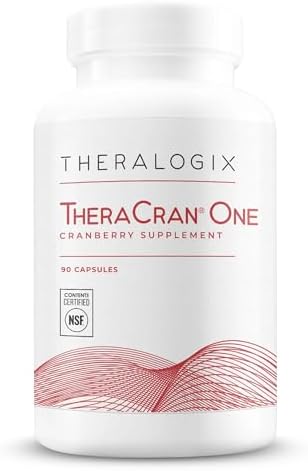
Theralogix TheraCran One
10.0/10 Our score
Top score: it states its PAC and is on a public testing list
- PAC a capsule
- 36 mgThe dose trials linked to fewer UTIs
- A day
- 1 capsule$1.20 at the brand’s price
- Testing list
- NSF/ANSI 173Checks the capsule holds what the label says
- Bottle price
- $107.74List price for 90 capsules; the store often shows a sale price
Why we pick it It states 36 mg of A-type PAC, the cranberry compound studied for UTIs, in one capsule. It is on NSF/ANSI 173, a public testing list. It is what our readers buy most.
What you give up It costs more a day than drugstore cranberry. Those labels do not say how much PAC they hold, so you cannot tell if they reach the studied amount.
Which cranberry supplement is right for you?
What you pay for in a cranberry pill is its PAC. So we compare products that state their PAC, and we flag the ones that do not.
Want D-mannose in the same pill?
TheraCran Max adds 1,000 mg of D-mannose, a sugar many people take for UTIs, to 40 mg of PAC in 2 capsules. It is on the same NSF list. It costs $1.34 a day at the brand’s price, a little more than our pick.

Theralogix TheraCran Max
10.0/10 · $1.34 a day · NSF/ANSI 173
Buying a drugstore brand?
AZO and Solaray cost less a day, and Nature Made costs less a bottle. But their labels give milligrams of cranberry or “Pacran,” not milligrams of PAC, so you cannot tell if a dose reaches the 36 mg studies used. That is why we do not score them.
Have a UTI right now?
See a doctor. Cranberry is not a treatment for an active infection. It was studied for lowering the chance of getting another one. See our cranberry guide for what the research found.
Cranberry supplements we compared
We score a product only if its label states its PAC and its brand sells it in the US at a price we can check. Scored products come first, by score, then the rest, with why each one is or is not a pick. Costs are per 36 mg of PAC (one day) at each brand’s own price.
| Cranberry | A day | Why it is or is not a pick |
|---|---|---|
| Theralogix TheraCran One10.0/10 | $1.20 | Our pick: 36 mg PAC a capsule, on NSF/ANSI 173 |
| Theralogix TheraCran Max10.0/10 | $1.34 | 40 mg PAC plus 1,000 mg D-mannose; on NSF/ANSI 173 |
| ellura CranberryNot scored | No US price | Says 36 mg PAC; no US brand store and may be discontinued |
| AZO Cranberry softgelsNot scored | No PAC to price | Label gives mg of Pacran cranberry, not PAC |
| AZO Cranberry capletsNot scored | No PAC to price | Label gives mg of Pacran cranberry, not PAC |
| Solaray CranActinNot scored | No PAC to price | Label gives mg of extract, not PAC; 4 capsules a day |
| Nature Made CranberryNot scored | No PAC to price | Label gives mg of cranberry, not PAC |
How to read a cranberry label
Look for “PAC” with a number of milligrams, ideally with the lab method (DMAC, the standard PAC test). A line like “500 mg cranberry” or “equal to a glass of juice” does not tell you the PAC. Ignore vitamin C and “urine acidifying” claims; the PAC is what was studied.
Does cranberry work?
A 2023 Cochrane review found that cranberry products lowered the chance of repeat UTIs in women who get them often, in children, and in people at risk after medical procedures. It did not find a benefit for older adults in care, pregnant women, or people whose bladder does not empty well (Williams 2023). A 2024 review found trials at 36 mg of PAC a day or more lowered UTI risk by about 18% (Xiong 2024). It does not treat an infection you already have. More in our cranberry guide.
Questions people ask
What is PAC, and why does it matter?
PAC (A-type proanthocyanidins) is the cranberry compound studied for stopping E. coli from sticking to cells, in lab tests of urine (Howell 2010). Trials of 36 mg a day or more lowered the chance of a UTI by about 18%; lower doses showed no clear drop (Xiong 2024). Most labels give milligrams of cranberry instead, which does not tell you the PAC.
Can cranberry treat a UTI I have now?
No. A supplement is not a treatment for an active infection. If you have UTI symptoms, see a doctor. Cranberry was studied for lowering the chance of the next one.
Is cranberry juice as good as a capsule?
Juice has sugar and a PAC amount you cannot check. A capsule that states its PAC lets you know you get 36 mg. How much cranberry to take.
How we score
Five marks: does a serving hold the studied 36 mg of PAC; is the product on a public testing list; what 36 mg of PAC costs at the brand’s own price against the cheapest; does the label state the PAC; and the brand’s FDA recall record. Dose and testing are worth up to 3 points each, cost up to 2, label and recalls up to 1 each, for 10 in all. More on our method.
Sources
- Williams G, et al. “Cranberries for preventing urinary tract infections.” Cochrane Database Syst Rev. 2023. PubMed 37068952
- Xiong Z, et al. “Cranberry supplementation for the prevention of urinary tract infections: a meta-analysis.” Front Nutr. 2024. PubMed 39668896
- Howell AB, et al. “Dosage effect on uropathogenic Escherichia coli anti-adhesion activity in urine following consumption of cranberry powder standardized for proanthocyanidin content.” BMC Infect Dis. 2010. PubMed 20398248
- Testing list: NSF/ANSI 173, read August 25, 2026. PAC, prices and labels from each brand’s own page.